Each industry imposes specific constraints on airflow, noise, temperature, ingress protection, and certification. Select an application to see which fan types and motor configurations we recommend for that operating environment.
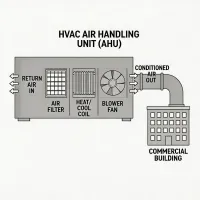
Supply and return air fans for air handling units, fan coil units, and rooftop packages. EC motors enable demand-based airflow modulation that reduces energy consumption by 30-40% at part load. IP54 protection standard for indoor installations.
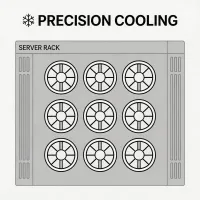
High-density server cooling requires precise airflow control with minimal noise. Our EC fan arrays deliver redundant N+1 cooling with hot-swap capability and individual fan speed monitoring via SNMP or BACnet integration for building management systems.
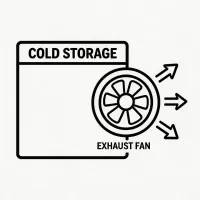
Washdown-rated fans with IP65/IP66 protection for wet processing areas. Stainless steel housings available for corrosive cleaning agents. Cold storage exhaust fans rated to -40C continuous operation with anti-condensation heaters on motor windings.
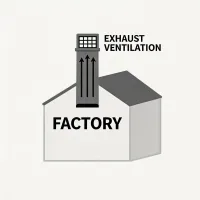
Fume extraction, process air supply, and general ventilation for production floors. ATEX-rated fans available for Zone 1 and Zone 2 hazardous areas where flammable gases or combustible dust may be present.
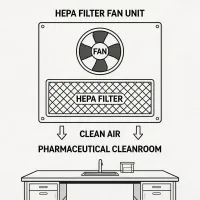
Fan filter units (FFUs) with EC motors for ISO Class 5-8 cleanrooms. Precise airflow uniformity across the filter face, low vibration to protect sensitive processes, and integrated speed control for cleanroom pressure cascade management.
Evaporator fans and condenser fans for walk-in coolers, blast freezers, and transport refrigeration units. Low-temperature motor bearings and anti-icing blade profiles maintain performance in sub-zero environments.
Choosing between EC (electronically commutated) variable-speed motors and AC fixed-speed motors is one of the most consequential decisions in fan specification. Neither option is universally superior — the right choice depends on load profile, energy cost, and application type.
EC motors deliver 30-50% energy savings at part-load conditions, which account for 70-80% of operating hours in HVAC applications. Precise speed modulation via 0-10V or PWM enables demand-based airflow control with soft-start capability that reduces mechanical stress on bearings and impellers. However, EC motors carry a 40-60% higher purchase price versus equivalent AC motors, and field repair is more complex because the integrated electronics require factory service or complete motor replacement rather than simple rewinding.
AC induction motors cost less upfront, are widely available from multiple suppliers, and can be rewound locally when they fail. For constant-load applications — process exhaust, continuous fume extraction, or fixed-duty condenser fans — the efficiency penalty at full load is marginal (2-5% versus EC) and the simpler controls reduce installation and commissioning time. The trade-off is higher energy consumption at part load and the absence of built-in speed modulation, which requires an external variable frequency drive (VFD) adding $200-$800 per motor depending on power rating.
For applications with variable load profiles (HVAC, data center cooling, cleanroom pressure control), EC motors typically reach payback in 18-30 months based on energy cost savings alone. For constant-duty industrial exhaust at full speed, AC motors remain the lower total cost option over a 10-year lifecycle when maintenance simplicity is weighted alongside energy cost.
Every fan operates within defined performance boundaries. Specifying a fan outside these limits leads to premature failure, excessive noise, or insufficient airflow. The following constraints apply across our product lines:
Standard motor windings are rated to Class F insulation (155C maximum winding temperature). At ambient temperatures above 60C, motor derating applies — typically 5% capacity reduction per 10C above rated ambient. Cold storage fans rated to -40C require optional anti-condensation winding heaters; without them, moisture ingress during defrost cycles can degrade insulation within 12-18 months.
Axial fans are inherently limited to low-to-medium static pressure applications (typically below 500 Pa). Specifying an axial fan into a high-resistance duct system causes the fan to operate in stall, producing excessive noise, vibration, and rapid bearing wear. High static pressure applications above 1,000 Pa require centrifugal fan types with backward-curved impellers, which are larger and heavier.
Sound power increases roughly as the fifth power of impeller tip speed. Doubling the airflow of a given fan by increasing speed raises noise by approximately 15 dB(A). Meeting stringent noise requirements (below 50 dB(A) at 1m) while maintaining high airflow demands larger, slower-running fans — which increases physical size and cost. There is no fan design that simultaneously minimizes noise, size, and cost at a given airflow target.
We match fan type, motor class, protection rating, and certifications to your specific environment.
Describe Your Application